A touch panels much more than just a transparent surface. Its internal structure, conductive materials, manufacturing precision, and electrical design all determine whether it can operate reliably and stably in real-world applications.
For industrial equipment manufacturers, selecting the right industrial touch panel goes far beyond simply comparing screen sizes or interfaces. To ensure stable operation in complex environments, it is essential to understand how the working principles, manufacturing processes, and structural design of a touch panel impact the product's durability, accuracy, and long-term operational stability.
SKY-TDM primarily provides customized touch panel solutions for industrial control systems, medical equipment, automotive electronics, self-service kiosks, and other applications that require reliable human-machine interaction.
Our product portfolio includes Projected Capacitive (PCAP) touch panels, as well as 4-wire, 5-wire, and 8-wire resistive touch panels. Each technology features its own unique working principles, structural designs, and manufacturing processes, making them suitable for distinct application areas.
PCAP (Projected Capacitive) touch panels achieve precise touch control by detecting changes in the electric field, whereas resistive touch panels achieve this by detecting electrical signal variations caused by physical contact between conductive layers.
Although both technologies allow users to interact directly with the display, they differ significantly in terms of materials, electrode configurations, and assembly processes.
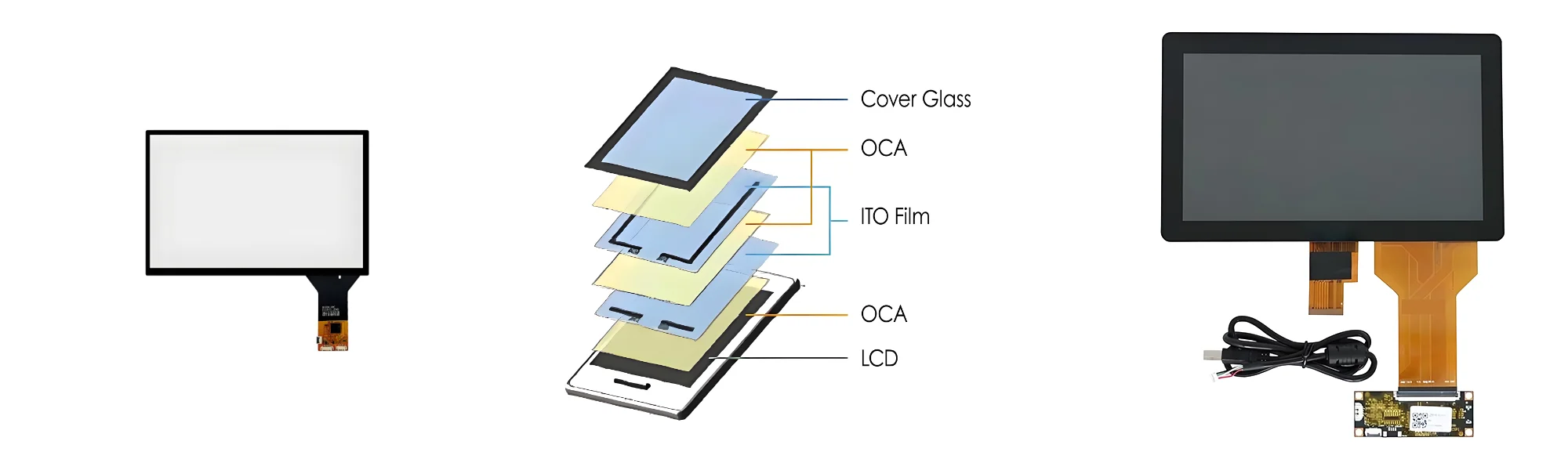
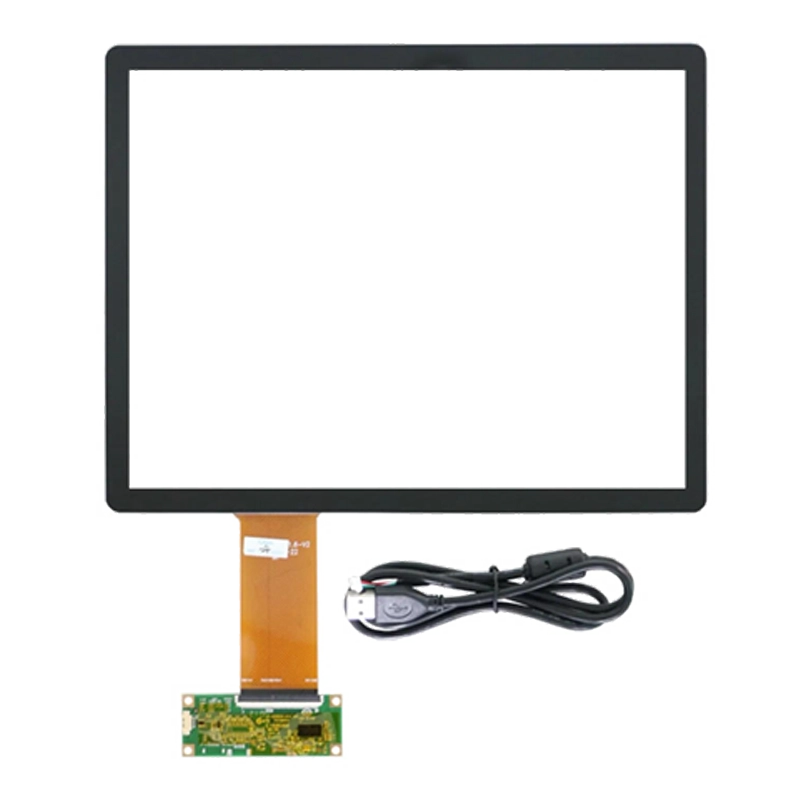
The structure of a PCAP touch panel consists of the following components:
● Cover glass or other suitable cover surface components
● Transparent conductive electrode layers
● Insulating and supporting materials (e.g., OCA, SCA)
● Flexible Printed Circuits (FPC)
● Touch screen controller board
Each configuration offers different trade-offs among optical performance, mechanical properties, thickness, and cost, making them adaptable to various application scenarios.
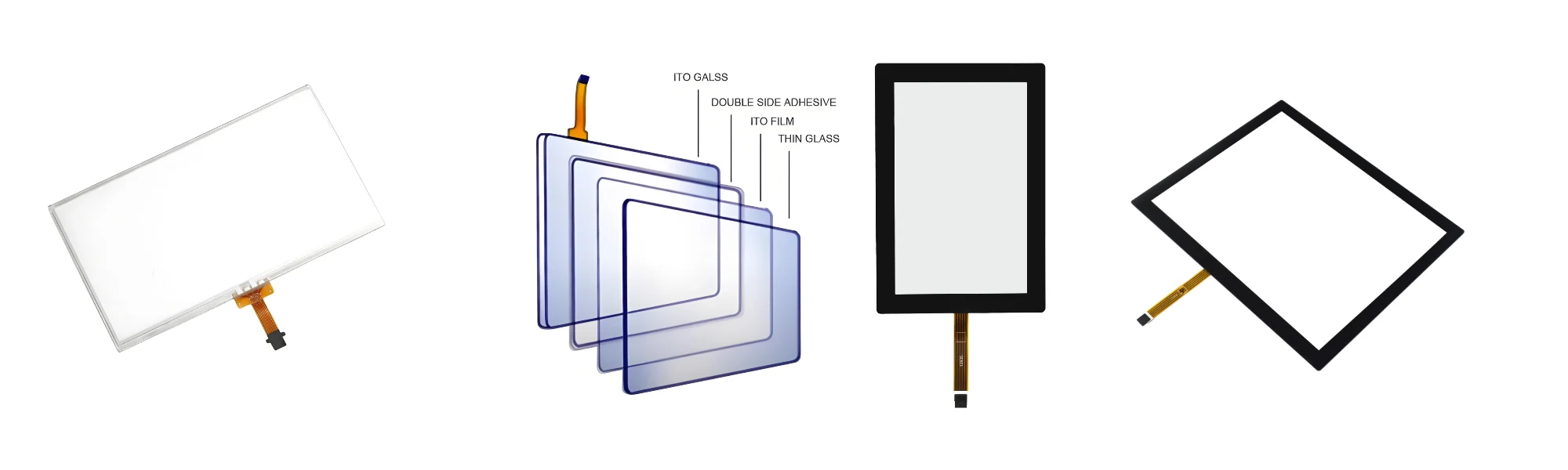
The structure of a resistive touch panel typically consists of two conductive layers separated by microscopic insulating spacer dots.
The top layer is usually a flexible film coated with a transparent conductive material, while the bottom layer is glass or another substrate with a conductive coating.
When a user presses the screen surface, the top layer deforms to make contact with the bottom conductive layer. The controller then measures the resulting electrical signals to determine the exact touch location.
Depending on specific design requirements, it may also include protective coatings, edge tapes, flexible cables, and mechanical support components.
This pressure-based working principle not only allows resistive touch screens to support bare-hand operation but also makes them compatible with gloved operation and the use of appropriate styluses or hard objects.
Manufacturing PCAP capacitive touch panels requires precise control over conductive traces, optical surfaces, alignment accuracy, and electrical connections.
Although the manufacturing process varies depending on the sensor materials and structural design, the main production stages typically include the following steps.
The manufacturing process involves the inspection of cover glass, sensor substrates, transparent conductive materials, Flexible Printed Circuits (FPC), adhesive tapes, and other components. Material quality directly impacts optical clarity, electrical performance, lamination reliability, and the mechanical strength of the final product. For industrial projects, material selection is determined based on the equipment's operating environment and mechanical requirements.
Depending on the design requirements, cover glass undergoes processes such as cutting, edge grinding, drilling, polishing, and chemical strengthening. Custom silk-screened borders, logos, decorative patterns, and mounting features can also be applied. Subject to the compatibility of the chosen materials and design, surface treatments such as Anti-Glare (AG), Anti-Reflection (AR), Anti-Fingerprint (AF), and anti-smudge coatings can be applied. These treatments help the touch screen adapt to different lighting conditions, cleaning procedures, and aesthetic requirements.
Capacitive sensors contain transparent conductive electrodes arranged in specific arrays to detect capacitance changes. The electrode trace patterns and routing designs determine how touch signals are detected and transmitted to the controller.
Depending on the sensor technology, the manufacturing process may involve photolithography etching, laser processing, printing, or other suitable methods. Production precision is critical, as defects in the conductive traces can negatively affect touch performance and product consistency.
The sensor must be electrically connected to the touch controller via an FPC. The bonding process requires precise alignment and controlled processing conditions. Reliable electrical connections help minimize connection failures and ensure stable communication between the sensor and the controller.
The cover glass and sensor are laminated together using an appropriate transparent adhesive. Lamination quality directly affects the product's appearance, optical performance, and mechanical integrity. During production, dust, bubbles, alignment deviations, and adhesive defects must be strictly controlled.
Finished PCAP capacitive touch panels undergo inspections for appearance, touch response, electrode continuity, and compatibility with the target controller. For specific projects, additional testing may include multi-touch performance, gloved-hand operation, water interference operation, wide-temperature operation, and Electromagnetic Compatibility (EMC) testing.
Material selection should primarily be based on the application scenario to avoid over-engineering and unnecessary cost increases. These advanced tests should not be assumed as standard configurations for every PCAP touch panel.
A 4-wire resistive touch panel typically consists of a flexible top conductive film and a bottom conductive substrate, separated by insulating spacer dots.
In a common design, the bottom substrate carries the X-axis electrodes, while the top film carries the Y-axis electrodes. When pressure brings the two conductive surfaces into contact, the controller applies voltage to the corresponding electrode set and measures the resulting signals to calculate the touch coordinates. The manufacturing process generally includes:
● Material Preparation: Selecting PET films, conductive substrates, spacer materials, adhesive tapes, and Flexible Printed Circuits (FPC) based on panel specifications.
● Conductive Layer Processing: Utilizing appropriate manufacturing processes to fabricate the resistive surfaces and electrodes.
● Spacer Dot Formation: Printing uniform insulating dots on the conductive substrate to ensure the conductive layers remain separated when the panel is not being pressed.
● Silk-screening and Peripheral Processing: Manufacturing decorative borders, insulating patterns, or other specified features as required.
● Lamination and Assembly: Aligning and assembling the top film and bottom substrate while maintaining the required spacing and mechanical characteristics.
● FPC Connection and Inspection: Completing the electrical connections, followed by inspections for coordinates, resistance, appearance, and functionality.
A 4-wire resistive touch panel is a highly cost-effective solution.
A 5-wire resistive touch panel features a different electrode configuration compared to the 4-wire version. In a typical design, the bottom conductive substrate serves as the sensing surface, with electrodes at the four corners establishing the measurement electric field, while the top conductive film primarily acts as a voltage sensing layer.
An 8-wire resistive touch panel builds upon the traditional 4-wire architecture by adding extra connections to achieve more stable electrical measurements.
Selecting the appropriate touch screen depends on the specific application scenario:
4-wire resistive touch panels are best suited for applications with strict cost constraints.
5-wire resistive touch panels are highly ideal for industrial applications involving high-frequency operations, frequent contact, and an expected long service life.
8-wire resistive touch panels are suitable for harsh environments where superior stability is required.
Different industrial environments have varying requirements for a combination of touch performance, durability, optical quality, and operational flexibility.
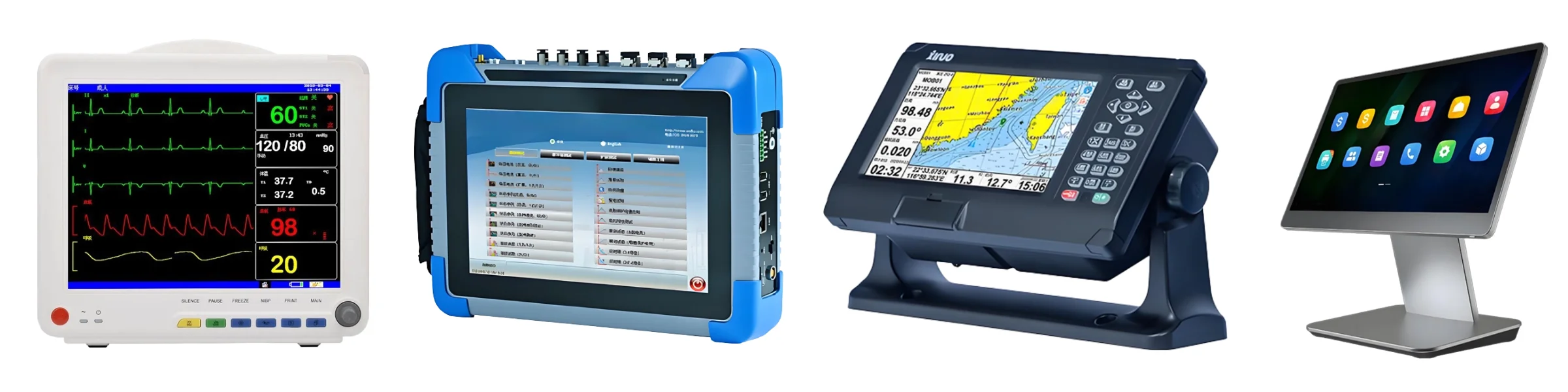
Industrial Automation and Human-Machine Interfaces (HMI)
Industrial control panels typically require stable touch response, reliable operation, and compatibility with equipment control systems.
PCAP touch screens are ideal for interfaces that require a glass surface, intuitive operation, and multi-touch capabilities. Conversely, resistive technology is suitable for applications requiring pressure-based input or compatibility with various gloves and styluses.
Medical Equipment
Medical instruments require surfaces that are easy to clean, controlled mechanical dimensions, and reliable touch response.
PCAP touch panels feature a smooth glass front panel design, while resistive panels are well-suited for instruments where pressure input and compatibility with dedicated pointing tools are priorities.
Self-Service Kiosks and Industrial Equipment
Self-service kiosks, vending machines, printers, and equipment interfaces may require customized cover glass, mounting dimensions, FPC routing, and controller compatibility.
PCAP touch panels provide a modern user experience, whereas resistive technology is better suited for applications with specific input requirements or strict cost constraints.
Transportation and Outdoor Equipment
Railway systems, marine electronics, charging stations, and outdoor control terminals often face challenges such as temperature fluctuations, moisture, vibration, or high ambient light.
In these applications, the touch screen must be evaluated as an integral part of the overall system. Factors like cover glass, sealing design, adhesives, controller settings, display brightness, and mechanical mounting methods all affect overall reliability.
Whether using PCAP or resistive technology, one cannot assume that they inherently possess waterproof, sunlight-readable, or environmental protection capabilities without proper design and validation.
When selecting an appropriate supplier, it is recommended to consider the following factors:
● Experience in PCAP and resistive touch panel structures
● Availability of 4-wire, 5-wire, and 8-wire resistive configurations
● Capability in material selection and structural customization
● Process control over sensor fabrication, silk-screening, lamination, and assembly
● Compatibility with FPCs and touch controllers
● Dimensional accuracy, along with comprehensive quality control records and procedures
● Prototyping support and mass production consistency
● Technical communication efficiency and long-term supply capability
We provide customized touch panel solutions for OEM and ODM projects, assisting clients in comprehensively evaluating touch panel structures, materials, dimensions, electrical connections, and application requirements.
Whether you require PCAP capacitive touch panels or 4-wire, 5-wire, and 8-wire resistive touch panels, we can select the optimal mechanical solution that meets your equipment's functional, mechanical, and environmental requirements.
Welcome to contact SKY-TDM to discuss PCAP capacitive touch panels, 4-wire, 5-wire, and 8-wire resistive touch panels, and let us tailor a touch panel solution for your next project.